From New Wave to Synth-Pop: How Synthesizers Took Over the Charts
In a few years around 1980 the synthesizer went from an experimental tool to the lead instrument on British number ones. Here is how new wave turned into synth-pop, what the technology changed, and where the sound went next.
At the end of the 1970s most hit records were still built on guitars, bass, drums and piano. A few years later, synthesizers and drum machines were playing the lead parts on some of the best-selling singles in Britain, and British acts using them were regulars on American video channels. That change happened fast, and it came out of the same post-punk moment that produced new wave.
This guide follows the route from new wave to synth-pop: the earlier music that prepared the ground, the first electronic hits, why cheaper technology mattered so much, the chart peak of the early 1980s, and the revivals that keep returning to the sound. It closes with practical ways to explore the style on Music Soil.
New Wave: The Umbrella Term After Punk
New wave grew up in the United States and Britain in the mid-to-late 1970s. At first the term meant much the same as punk, but it soon described a lighter, more melodic offshoot. Seymour Stein of Sire Records helped popularise it as a catch-all for the music that came after punk, and the name nodded to the French New Wave in cinema.
Typical new wave records used choppy rhythm guitar, angular riffs, quick tempos and keyboards, often with a deliberately nervous or quirky image; Talking Heads, Devo and Elvis Costello are standard examples. Because the label was so wide, it ended up covering power pop, two-tone ska and early synth-pop as well. It also had local versions across Europe, including Germany’s Neue Deutsche Welle, Spain’s La Movida Madrileña and the coldwave scenes of France, Belgium and Poland.
The Ground Work: Krautrock, Disco and Early Electronics
Synthesizers were not new in 1978. Robert Moog’s synthesizer dates from 1964, and the portable Minimoog was taken up by progressive rock keyboard players. In continental Europe, krautrock bands such as Kraftwerk, Tangerine Dream, Can and Faust made synthesizer-heavy music that later electronic pop drew on heavily, as did Brian Eno’s work.
Several individual records also mattered. Wendy Carlos’s electronic soundtrack for A Clockwork Orange (1971) was later named as an inspiration by Philip Oakey of the Human League. Kraftwerk’s first British show in 1975 persuaded Andy McCluskey and Paul Humphreys, who went on to form Orchestral Manoeuvres in the Dark (OMD), to swap guitars for synthesizers. Giorgio Moroder’s programmed production on Donna Summer’s “I Feel Love” (1977) shaped later electronic pop rhythms, and David Bowie’s Berlin albums with Eno were widely influential.
From Post-Punk to the First Electronic Hits
Early punk was suspicious of the synthesizer, which it saw as inauthentic. Yet punk’s do-it-yourself attitude also removed the idea that you needed years of training to play one. Many post-punk and new wave acts took advantage. The New York duo Suicide used drum machines and synthesizers on their 1977 debut album, and in 1978 the Human League’s “Being Boiled” and the Normal’s “Warm Leatherette” became early landmarks of what would be called synth-pop. In Japan, Yellow Magic Orchestra brought the Roland TR-808 drum machine into pop and became a major influence on British acts.
The commercial breakthrough came in 1979. Gary Numan, then in Tubeway Army, had found a Minimoog left in a studio by another band and reworked the group’s material around it. “Are Friends Electric?” went to number one in Britain that summer, and his solo single “Cars” followed it as another major hit. The same year OMD released “Electricity”, and the Buggles’ “Video Killed the Radio Star” reached the top of the UK chart; two years later it was the first song played on MTV.
Why the Technology Changed the Sound
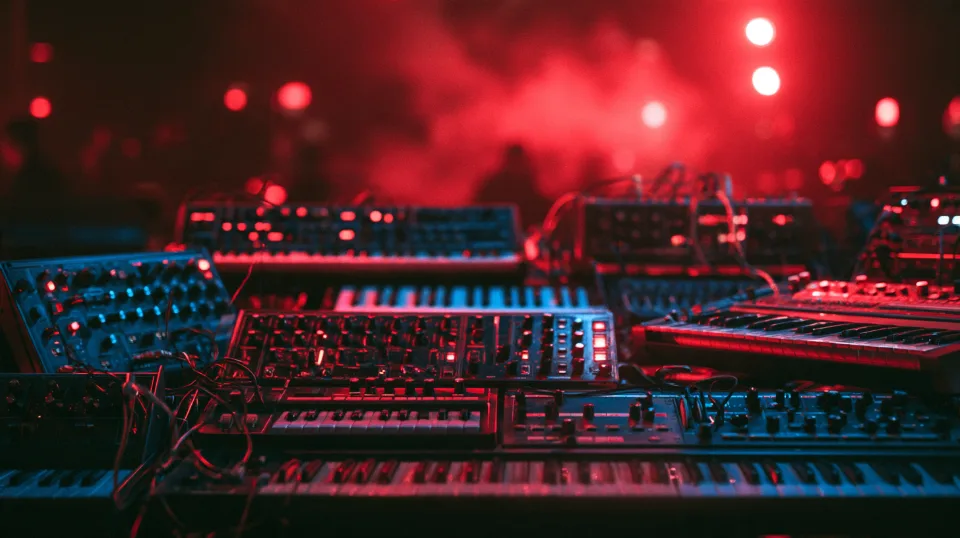
Synth-pop is defined less by a rhythm or a chord style than by its tools: synthesizers, drum machines and sequencers, sometimes replacing every other instrument. Early machines were often monophonic, able to play only one note at a time, so the first wave of records tended to be sparse, built from repeated riffs, and often cool or detached in tone. Isolation and city life were common subjects.
In the early 1980s synthesizers became cheaper and easier to use. Polyphonic instruments arrived, and the MIDI standard, defined in 1982, made it far simpler to connect machines and control them together. Combined with dance beats, this produced a warmer, catchier sound that fitted the three-minute pop single. It also changed band sizes: one person with keyboards could cover the whole arrangement, which is why so many synth-pop acts were duos built around a singer, with expressive voices such as Marc Almond, Alison Moyet and Annie Lennox at the front.
Not everyone welcomed the shift. Synth-pop was criticised as cold and soulless, and in early 1982 the Musicians’ Union tried to limit the use of synthesizers.
The Peak: New Romantics, MTV and a Second British Invasion
The New Romantic scene, which grew up around the London clubs Billy’s and the Blitz, gave synth-pop a strong visual identity. Spandau Ballet, Visage and Duran Duran came out of it, and Duran Duran are credited with adding dance beats that made the music warmer. In 1981 Depeche Mode had their first hits, and the Human League’s “Don’t You Want Me” and Soft Cell’s “Tainted Love” were Britain’s best-selling singles of the year. Synth-pop’s commercial high point in the UK came that winter, when acts including OMD, Ultravox, Soft Cell, Depeche Mode and Yazoo all had top ten hits.
In the United States, MTV reached New York and Los Angeles in 1982 and played a large number of British videos. A Flock of Seagulls’ “I Ran (So Far Away)” is generally seen as the first British hit to reach the Billboard top ten through video exposure, and Eurythmics’ “Sweet Dreams (Are Made of This)” went to number one there in 1983. The wave of British success became known as the Second British Invasion. Elsewhere in Europe, synth-pop sat alongside Eurodisco and Italo disco, with hits for acts such as Alphaville and Propaganda from Germany, Yello from Switzerland and Telex from Belgium. Norway’s a-ha took “Take On Me” to number one in the US in 1985.
Fading Out, Then Coming Back
In the second half of the 1980s, duos such as Pet Shop Boys and Erasure moved the style closer to dance music, while in Britain guitar-based indie rock was gaining ground. By the end of the decade synth-pop was giving way to house and techno, and in the early 1990s American alternative radio turned toward grunge. Synth-pop still left a direct mark on house music and Detroit techno.
The sound returned in stages. Indietronica mixed indie and electronic music from the early 1990s. Electroclash began in New York at the end of the decade, combining synth-pop, techno, punk and performance art, with artists such as Peaches and Fischerspooner. Around 2003 and 2004, records by Ladytron, the Postal Service and the Killers brought vintage synthesizer sounds back toward the mainstream, and Lady Gaga’s “Just Dance” (2008) was followed by a run of electronic pop singers such as La Roux and Little Boots.
Synthwave, a mostly instrumental style that developed in the mid-to-late 2000s, looks back to 1980s film and video game soundtracks rather than the charts, drawing on composers such as John Carpenter and Vangelis. Its profile rose through the film Drive (2011) and the series Stranger Things. In 2020 the Weeknd’s synthwave-styled “Blinding Lights” reached number one in 29 countries, a reminder of how far the sound now travels.
How to Explore Synth-Pop on Music Soil
The history above suggests a few practical routes:
- Start on the Synth-pop genre page and check its Related genres box, then compare it with close styles such as electropop and dance-pop.
- On Discover, select synth-pop, set Years to the late 1970s and early 1980s, and sort by Oldest to hear the first wave before the polished chart era.
- Add a country to compare scenes: the United Kingdom for the British boom, then Germany or Japan for the other early centres.
- Select new wave and synth-pop together with Match All to find artists listed under both, the acts that sit right on the border between the two.
- For the revivals, try electroclash, indietronica or synthwave and sort by Newest.